
History
Devo: A History of De-Evolution and Synth-Pop Innovation
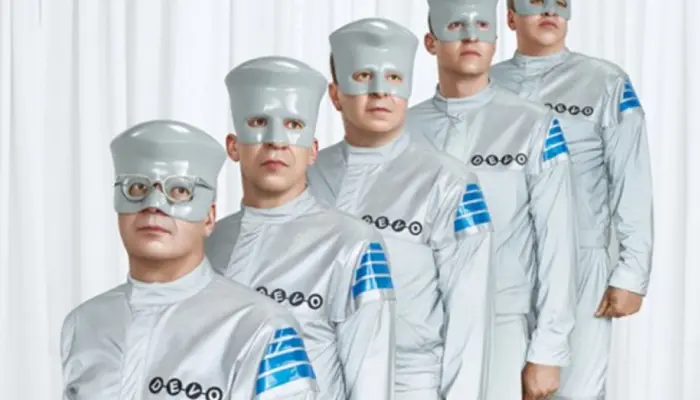
Devo, an American new wave band, emerged from Akron, Ohio, in 1972, leaving an indelible mark on the music landscape with their unique blend of satire, science fiction, and unconventional instrumentation. While the band officially disbanded in 1991, they reunited in 1996 and continue to perform, currently featuring Gerald Casale on vocals and bass, Mark Mothersbaugh on vocals and synthesizer, Bob Mothersbaugh on guitar, and Josh Freese on drums.
The band's sonic identity has been described variously as punk, industrial, and rock, but they are most recognized as pioneers of the 1970s and early 1980s new wave movement, significantly influencing the synth-pop genre that defined the 1980s, alongside contemporaries like Gary Numan and The B-52s.
Devo's artistic output is characterized by a distinctive fusion of kitsch science fiction themes, deadpan surrealist humor, and sharp social commentary. Their music often explores the concept of "Devolution," or de-evolution, presented through often discordant pop songs that frequently incorporate unusual synthetic sounds and unconventional time signatures.
The band's innovative music videos were particularly influential in the nascent days of MTV, and their work has had a profound impact on subsequent generations of musicians, especially within the new wave, alternative, and grunge genres.
The Genesis of Devo: From Art Concept to Musical Force
The name "Devo" directly stems from the concept of Devolution, a philosophical idea developed as an artistic statement by Kent State University art students Gerald Casale and Bob Lewis in the late 1960s. Casale and Lewis explored this concept through various art projects. Around 1970, they connected with Mark Mothersbaugh, who introduced them to the pamphlet "Jocko Homo Heavenbound," which would later inspire one of Devo's signature songs.
A pivotal moment in the band's formation was the tragic Kent State shootings on May 4, 1970. Casale, who knew some of the students who were killed, experienced a profound shift in perspective. He has stated that this event transformed the abstract idea of Devolution into a serious and urgent concept.
The initial iteration of Devo, known as Sextet Devo, performed at the 1973 Kent State performing arts festival. This early lineup included Casale, Lewis, Mothersbaugh, Gerald's brother Bob Casale on guitar, and Rod Reisman and Fred Weber on drums and vocals. This performance was documented and featured in the home video "The Complete Truth About De-evolution."
By 1974, Devo returned to the stage at the Creative Arts Festival with a lineup featuring the Casale brothers, Bob Lewis, Mark Mothersbaugh, and Jim Mothersbaugh on drums. The band later solidified as a quartet centered around Mark Mothersbaugh and Gerald Casale, joined by Mark's brothers Bob Mothersbaugh on electric guitar and Jim Mothersbaugh on homemade electronic drums. This lineup remained until Jim's departure in 1976. Bob Lewis occasionally contributed guitar during this period. Early Devo concerts were known for their confrontational nature and theatrical elements, with members adopting personas like Booji Boy.
Following Jim Mothersbaugh's exit, Bob Mothersbaugh recruited drummer Alan Myers, whose precise, conventional drumming style became a key component. Gerald Casale also brought his brother Bob Casale back into the fold, establishing the lineup that would endure for nearly a decade.
In recent years, Devo has continued to engage with their audience. They embarked on a Euro-Tour in 2007, performing in cities across Europe. In May 2020, the band launched an online store selling face masks and Energy Dome protective shields, aimed at helping fans protect themselves during the COVID-19 pandemic.